


The general flowchart of a crane structure residual life assessment could be split into two basic stages. On the first stage crane structure critical elements are determined usually using the Finite Element Analysis (FEA) for the given operational parameters (i.e. safe working load, maximum outreach and back reach, speed of mechanisms etc.). On the second stage the fatigue life of the critical elements is calculated using the same Finite Element (FE) model.
The key factor for such approach is the availability of the crane structural drawings, which allows to create precise FE model. And here the main problem appears that to find the drawings for the old machines is sometimes either a big problem or even impossible (i.e. the manufacturer company does not exist anymore). Similar problem could be challenging even for new cranes. The approach described in this paper allows to overcome the drawing absence problem by using the following modifications of the aforementioned procedure: critical elements are found using Non Destructive Testing (NDT); FE models of the critical areas are created using local structure measurements; FE analysis is performed using strain gauge measurements for Boundary Conditions during the crane operation.
The main flow of the proposed approach is that the residual life could be calculated for the crane operational parameters, the measurements have been performed for. Despite the paper uses crane structure as an example, the approach is general and it could be transferred on different types of steel structures.
In the engineering practice the mostly used approach for stress analysis is Finite Element Analysis (FEA). In order to perform the FEA for the crane structure the following information about the crane must be presented:
This information could be taken from the structural drawings of the crane. Normally the crane owner may have the drawings, but in reality, it is quite hard to find the drawings especially for the machine that has been in operation for more than 20 years. Of course, one more way to find this information is to contact the crane manufacturer. However, it could lead at least to additional expenses to buy those drawings or sometimes the company does not even exist anymore and it is impossible to enquire the documents.
In this paper the approach that allows to overcome the structural drawing absence problem is proposed. As an example, the approach is used for 38-year-old Quay Grab Unloader residual life estimation as the FEA is a basic part of such type of project.
The idea of the approach is to find several critical elements of the crane, create the FE submodels for each of them based on geometrical measurements, performed on site. And instead of taking the boundary conditions (the forces that represent the action of the rest of the crane on the submodel) for these submodels from the whole crane Finite Element Analysis, get them from the processing of strain gauge signal measured during crane operation.
The residual life assessment approach for the considered Grab Unloader consists of the following steps
More detailed description of each step is given farther on.
The crane critical elements have been found using the following two methods separately: structural survey; crane structure accumulated fatigue damage measurement. The obtained results have been analyzed and combined.
Structural survey. During the structural surveying the fatigue cracks of significant length have been found in the sea side Trolley Girder Support Beam (TGSB), near its center, where pulleys are attached Fig. 1. Thus, the critical element based on structural survey is TGSB central part.

Crane structure accumulated fatigue damage measurement. The approach is based on measured coercive force parameter. The measured coercive force is in proportion with the fatigue damage accumulated in the element. For each grade exists the coercive force critical magnitude that shows that the further operation is dangerous and could lead to structure failure. For the simplicity the whole range of the coercive force is split into several intervals: Reliable operation, Controllable operation, Critical Operation [1, 2, 3, 4]
The method could be used for the residual life estimation for the tested grades only, where the critical value of the coercive force is found. For the Grab Unloader grade the study of changing coercive force vs number of stress cycles does not exist. That is why only comparison analysis that shows the critical elements could be done instead of finding the residual life directly for each element. The critical elements are the ones with the biggest coercive force magnitude.
Based on the measured coercive force parameter it appears that the critical elements are Boom and Girder.
Combining the surveying results the following critical elements have been taken for the further residual life assessment (see Fig. 2):

Based on the geometrical measurements performed on site (i.e. member cross section height, width, flange and web thicknesses, bulkheads’ and stiffeners’ geometry etc.) the FE models of the critical elements have been created. As the further analysis is planned to utilize the Linear Fracture Mechanics approach one or two cracks have been introduced acc. [5] to each submodel (there are several models for each critical element where the only difference is the crack length). The cracks’ positions are based on preliminary analysis of the element without crack and the cracks were introduced in the areas with the biggest stress range. Each crack is oriented to be normal to the first principal strain. The linear material behavior model is used.


Concept. Firstly, we have to find out the normal and shear stress distribution in a cross section which is used for the further boundary condition application. Then we could decide about the minimum amount of the strain gauges, their axis directions and positions along the section.
Stress distribution in cross section. For the normal and shear stress distribution the thin wall section beam theory is used. In crane structures the most frequently used types of cross sections are box and I beam types. As soon as all three critical elements of the Grab Unloader have box cross section type, all further analysis is done for this particular cross section type. This approach could be easily used for another cross section type (i.e. I beam). The typical box cross section with internal forces and moments is shown in Fig. 6.

The appropriate stress type (normal and/or shear) is calculated for each load component and the resultant stress distribution is found as a stress superposition. The following rules for the stress signs are used acc. [6]:
For normal stress: tension stress is assumed to be positive; compression stress is assumed to be negative.
For shear stress: positive shear stress acts on positive faces of the material element in the positive direction of an axis. Also, positive shear stress acts on negative faces of the material element in the negative direction of an axis. A positive face has its normal vector in the positive direction of an axis, and a negative face has its normal vector in the negative direction of an axis.
Normal stress from normal to the cross section force Fx:


Stress superposition for all forces and moments is shown on Fig. 13.
On this stage we could decide about the minimum amount of strain gauges we need to reconstruct the stress distribution based on measurements. Having analyzed the stress distribution it could be concluded that:
In other words, we need to have measurements from at least two point along each edge to reconstruct the normal stress distribution and at least three points to reconstruct shear stress distribution.

The stress has been measured during 26 crane operational cycles using the modern 64-channel data acquisition device, Fig. 15. The device has several position sensors that were located along the Boom and Girder to show the trolley position during the measurements.

The strain gauges have been attached from the inner side of the structure. The gauges, positioned along and transversely to the critical element axis, were used; the positions are shown in Fig. 16 by arrows that are the gauge center lines.


The snippet of measured signals from the strain gauges vs time are shown in Fig. 17.
The calibration coefficient to convert measured signal in volts to strain has been taken from laboratory tests (for each channel) using the specially designed beam (Fig. 18) with varying width to provide constant strain all over its length.

On the first step strain gauge signal in volts was measured for test weights of 0, 0.5 kg, 1 kg, 1.5 kg and 2 kg. Then the corresponding strain magnitudes were calculated for all applied test loads using Strength of Material approach. This allowed to plot point in strain vs voltage axes.
On the second step the calibration coefficient was calculated using linear interpolation for strain vs voltage signal plot.
Using calibration coefficient Initial signal from the strain gauge (electrical voltage) has been converted to strain (Fig. 19, a; Step 1), then to stress (Fig. 19, b; Step 2), filtered out [7] and the stress cycles were extracted using Range-Pair Counting Method algorithm [8], Fig. 19.

Based on the stress at the points where the strain gauges are placed the stress distribution diagram along each plate edge has been reconstructed for normal (Step 3) and shear (Step 4) stresses, Fig. 20.

Finally, knowing number of FE along each edge, plate thickness and FE edge length, the stress to the FE edge has been converted to nodal forces, Fig. 21. In order to automatize the aforementioned steps C++ based programs and ANSYS APDL language macros have been used.


The following material tests have been performed to find out the degraded properties of the Ship Unloader grade:


It is found that
The residual life has been calculated acc. [9] based on linear fracture analysis, which utilizes Paris low:

The cycles with SIF amplitude which is more than 0 have been considered in analysis. Also cycles with compression stress in the crack tip have been excluded.
Having analyzed all three submodels (Boom, Girder and TGSB) it was found that the element with the lowest value of the residual life is the TGSB with the critical area of the sheave support flange connection. The residual life of the unloader after repair, based on the fatigue analysis of its critical element, is approximately 9.7 years. It has been assumed that the crane will work with the same regime (same Safe Working Load, mechanisms accelerations etc.).
Summary
Disadvantages of the approach
References
Maksym Starykov, Frank Van Hoorn2
1 PhD, Mechanical Engineer, Palfinger Marine, Bergen, Norway
2MSc, Naval Architect, Argonautics Marine Engineering, Inc, Windsor, USA
Corresponding author: Maksym, Starykov, starikovmax@yahoo.com
Submitted 06.05.2016; accepted date (use style Received dates, or Alt + Ctrl + R)
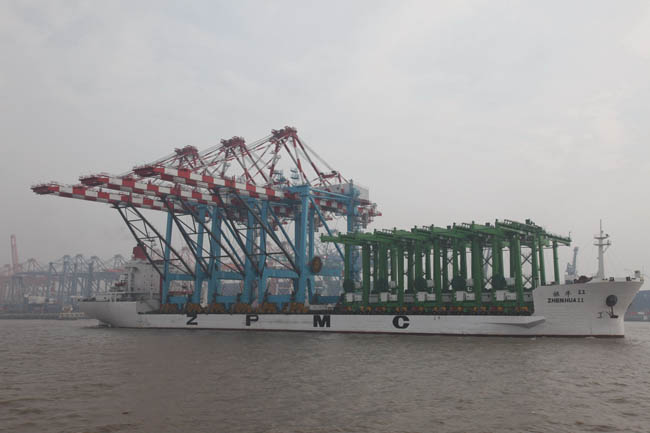
Abstract. For the last decades, fully erected container cranes have been delivered to a customer site by ships. On one hand, using this method of transportation is very attractive due to its cost and time savings. But on the other hand, being exposed to cycling loads from the ship motions during the sea voyage, the crane structure accumulates fatigue damage. Using the accumulated fatigue damage parameter, the crane transportation could be associated with the amount of the working cycles the crane could have worked out during its normal operating at the customer site. In the presenting paper the research for the real case of a new crane voyage from China to Ukraine has been done.
Keywords: crane sea transportation, fatigue damage accumulation, ship motion accelerations, finite element analysis, container crane, ship-to-shore crane, STS crane.
Introduction. In general practice of lifting cranes they could be delivered from the manufacturer factory to a customer site in two different ways:
1. Statement of research problems and the technique for their decision.
The main disadvantage of the crane delivery by means of sea transportation could be understood after a closer look at the cyclic loads, which act on the carried crane from the ship motions along the whole voyage. The loads could have quite significant magnitude and amount of cycles, which leads to fatigue damage accumulation (Murakami, 2012) in the crane elements and joints. In the other words it means that after a new crane is delivered by sea to the customer site it is not a new anymore, but has a condition which is equivalent to being in operation for some time.
Of course, each transportation case is individual and the following cases are possible:
The main goal of the current research is in finding out if the delivery of the fully erected Ship to shore crane by vessel damages the crane by decreasing its service life and in the case of positive answer assess this damage in terms of working cycles. The main parameter that is checked by structural engineers on the project preparation stage is the static strength of the crane structure, lashing elements, deck of the carrying vessel and all the reinforcements. Unfortunately, investigations of the influence of a fully erected crane transportation by sea on its residual life, which involves fatigue analysis of the structure but not only static strength, have not been found. In this paper, the analysis for specific case has been done in order to assess such influence.
Thus, the novelty of the current research is in the investigation of carried crane service life decreasing due to the sea voyage based on fatigue damage accumulation assessment.
A real case of a ZPMC© quay crane delivery from China to Ukraine has been used for this analysis. The route is shown in fig.1.
 Figure 1. The ZPMC vessel route, which transports the quay crane from Shanghai (China) to Yuzhne (Ukraine). The small green squares contain the date when the ship passed the point
The basic crane (fig. 2) parameters are as follows:

Figure 2. The quay crane general arrangement. The cross section of the container carrier with the numbers of container rows are shown at the right lower corner (#1-#20)
The cranes position on the ship during its transportation is shown in figure 3.
 a) a) |
|
 b) b) |
 c) c) |
Figure 3. The crane on the ship’s deck
The analysis of the crane has been split into three major stages. On the first stage the loads on the crane structure due to the ship motions have been calculated. The second stage involves finite element analysis for crane static strength under the influence of the mentioned above loads. On the last stage, based on the obtained stress data for the crane structure during the voyage and using a specially created program, fatigue damage accumulated in the crane structure has been calculated.
2. Loads from ship motion determination
Based on the limited data available, the ZHEN HUA 11 vessel was modeled based on the hull of a standard bulk carrier, converted into the crane carrier, with identical dimensions (similar to the real – full scale – conversion) (Van Hoorn, Container crane transportation option: Self-propelled ship versus towed barge, 2005), (F. van Hoorn, Wijsmuller Transport B.V. and S.D. Devoy, Matthews-Daniel Co.,, 1990). For the computer model of the resulting hull, see figure 4 the loading condition was prepared based on the crane and RTG data, estimated lightship of the vessel, and some additional weights for bunkers, ballast, and some miscellaneous. The approximate stowage plan is presented in figure 5.

Figure 4. MOSES© model of the vessel hull

Figure 5. Approximate stowage plan
The resulting loading condition is summarized in table 1.
Table 1. Loading condition ZHEN HUA 11 with 3 STSs and 5 RTGs
| Displacement | 60,300 | T |
| Draft bow | 6.9 | M |
| Draft aft | 8.6 | M |
| GM’ | 8.3 | m |
| Roll gyradius | 13.9 | m |
| Roll period | 12.5 | s |
For the environmental conditions for the voyage from Shanghai, China, to Yuzhne, Ukraine, the Global Wave Statistics were used. A combined voyage scatter diagram was made by adding all scatter diagrams for the areas crossed together, each weighted with a transit time factor. The same wave data base also provides wave direction statistics for the individual areas crossed (N. Hogben et al, 1986) (Van Hoorn, Heavy-Lift Transport Ships – Overview of Existing Fleet and Future Developments, 2008). Combining these with the transit times (exposures) resulting in the following probability for each class of wave heading:
With the combined total voyage scatter diagram and using the MOSES© software program, the vessel motions and point accelerations at the crane CG were calculated for each wave height – wave period combination. This resulted in double significant design acceleration scatter diagrams for each of the 3 main directions. For each direction, the linear accelerations were grouped in 0.1 g interval classes and the numbers in each class were totaled, as presented in table 2. The double or full cycle significant (mean of highest 1/3) values give a good representation of the accelerations acting on the crane CG in each of the three main directions.
The loads are represented by linear accelerations along all three axis that are considered to be applied to the crane center of gravity (table 2). Total amount of oscillations is 461 000, cycle time is 10 seconds.
Table 2. Accelerations applied at Center of Gravity of the crane structure due to the ship motions
| Acceleration range in units of “g” | Longitudinal acceleration oscillations (total)* | Lateral acceleration oscillations (total)* | Vertical acceleration oscillations (total)** |
| 0.0 – 0.1 | 459,324 | 345,259 | 424,125 |
| 0.1 – 0.2 | 1,676 | 77,234 | 33,430 |
| 0.2 – 0.3 | – | 26,347 | 3,292 |
| 0.3 – 0.4 | – | 7,867 | 148 |
| 0.4 – 0.5 | – | 3,443 | 5 |
| 0.5 – 0.6 | – | 549 | – |
| 0.6 – 0.7 | – | 209 | – |
| 0.7 – 0.8 | – | 59 | – |
| 0.8 – 0.9 | – | 32 | – |
| 0.9 – 1.0 | – | 1 | – |
* – includes static part
** – excludes static part 1g
For the crane structural analysis, its model with lashing elements has been created (fig. 6).
3. Model description
The crane model has been prepared using ANSYS© utilizing finite element approach for stress calculation (Madenci, E., Guven, I, 2006), (Arsian, 2015), (Stolarsky, T., Nakasone, Y., Yoshimoto, S., 2006). The following finite elements have been used (fig. 6):
BEAM – for modelling of crane main elements (as legs, girder, boom, A-frame, stays etc.) and reinforcement structures (as boom support and crane four corner additional supports).
LINK – for lashing ropes. Initial pretension (2 tones) in each rope has been modelled.
MPC – for modelling of joints with only rotational degree of freedom. In order to model the saddle pin behavior the boom-girder joint has been modelled with the rotation restrictions.
MASS – for modelling attached elements masses, as machinery, trolley rails, ladders and platforms, elevator etc.

a) the beam model with shown beam element sections

b) crane skeleton model (beam sections are turned off)
Figure 6. The crane finite element model
The linear model of a material behavior has been chosen with Young modulus of Pa and Poisson ratio of .
The model loadings have been applied during two phases: preparatory loading steps and main loading steps.
The first preparatory loading step corresponds to the quay crane situated on the ship deck just after its disposal. It means there are neither supporting nor reinforcing structures installed yet (fig. 7). The crane structure has been loaded by its self weight and prestressed lashing ropes. Under the applied forces the structure had the initial deformation. The crane support structures (boom propping frame including two lashing wire rope that connect middle of the frame with the boom; supporting tubes at all 4 corners of the gantry) have also been modelled on the first stage, but turned off using birth/death element technology.
On the second preparatory loading step, the crane support elements have been turned on (fig. 8), and started propping the initially deformed crane structure. The main point of the splitting the preparatory loading into two steps is to model real situation, when the support elements have been applied to the deformed crane structure and therefor the only stress that could appear in the reinforcement comes from ship motions and reinforcing elements self-weight.
The boundary conditions for the crane attachment to the ship deck modelling are shown in fig.9.

Figure 7. Crane structure considered on the first preparatory loading step

Figure 8. Crane reinforcement elements, turned on the second preparatory loading step

Figure 9. boundary conditions, applied to the crane structure at first and second phase
During the second phase the loading cases that represent the structure loading with acceleration (according to the table 2) due to the ship motions have been created (PADT and Jeff Strain, 2013). For each acceleration class two loading cases have been created with acceleration acting in two opposite directions. As far as the number of cycles are given for the acceleration range, in calculation the mean value of the acceleration class range has been used.
For instance, for the longitudinal acceleration class 0.2 – 0.3 g the mean value range of 0.25g has been taken and two loading cases have been created, first one with acceleration of +0.125g and the other with -0.125g. Subtracting the second loading case from the first one gives the loading case with the stress range in the crane structure.
In addition to the stress information for the further fatigue analysis, the information regarding structure elements fatigue classification (FAT class) (Draper, 2008) is needed. For this purpose the FAT class has been assigned to all elements of the crane main structure (fig.10).

a)

b)

c)
Figure 10. Elements with assigned FAT classes
For the last phase of the analysis the special program has been created (Stroustrup, 2014) that uses the external information about structure elements FAT classification and the stress for loading cases for input data. The algorithm of the program is shown in fig. 11.
The program utilizes the nominal stress approach acc. (BS EN 13001-2:2014 Crane safety. General Design. Load actions, 2014), (Hobbacher) and Palmgren-Miner cumulative damage rule (Jean Lemaitre, Rodrigue Desmorat, 2005), (Chaminda, 2015).

Figure 11. Customer fatigue analysis program algorithm
The result of the program operation is the information about accumulated fatigue damage in each element.
Basic assumptions, used in the program algorithm, are as follow
According to the recommendations for the fatigue analysis (Hobbacher) the critical accumulated fatigue damage value is 0.5 and according (FEM 1.001. Rules for the designing of hoisting appliances. 3rd edition, 1998) it is 1.0.
The results of the fatigue damage accumulation (Lee, 2005) for the crane exposed to longitudinal, vertical and transversal accelerations are shown in fig. 12 and 13. The maximal accumulated fatigue damage D of the range from 0.1 to 0.05 has been found in the boom diagonal beam (fig.12). The fig. 13 shows the elements with the maximal accumulated fatigue damage from 0.05 to 0.025.
 Figure 12. Elements with the maximal accumulated fatigue damage from 0.1 to 0.05 (boom diagonal, shown in red)
 a) a) |
 |
b) |
 |
c) |
Figure 13. Elements with the accumulated fatigue damage from 0.05 to 0.025 (shown in red)
The fatigue analysis shows that during the crane transportation on the deck of the ship the crane structure has been damaged by the loading cycles, initiated by the ship’s motions. Using the accumulated damage values the crane transportation could be associated with the amount of the working cycles the crane could have worked out during its normal operating at the customer site (table 3).
Table 3. Crane transportation association with its normal operation
| Critical Elements with accumulated fatigue damage and as the result decreased service life due to the transportation | Calculated Damage, accumulated during the sea transportation, Di | , Crane element’s life (maximal) lost during the crane transportation, based on critical value of fatigue damage D=1* | Crane element’s life lost (maximal) during the crane transportation, based on critical value of fatigue damage D=1, working cycles** | Crane element’s life (maximal) lost during the crane transportation, based on critical value of fatigue damage D=0.5 * | , Cran’e elements life (maximal) lost during the crane transportation, based on critical value of fatigue damage D=0.5, cycles *** |
| Boom diagonal beam, fig 9 | 0.1-0.05 | 10% | 200,000 | 20% | 400,000 |
| Leg parts, portal diagonals, lower TGS beam, sill beam, | 0.05-0.025 | 5% | 100,000 | 10% | 200,000 |
* the calculation is done
** assuming crane life of 2 million cycles, crane element lost life is
*** assuming crane life of 2 million cycles, crane element lost life is
Of course, not all elements that have accumulated fatigue damage are critical from the fatigue point of view for normal operation. The good example is the boom diagonal, which is almost not loaded during the crane normal exploitation.
4. Discussion of the obtained results
According to the obtained results of the fatigue damage calculation, accumulated during the crane transportation by sea, it appears that up to 20% of the crane life has been used during its transportation. The crane that came down to the customer’s port was not the new crane, but already “used”. The fact the crane had lost such significant part of its structure life could give the customer some negotiation freedom in terms of either price reduction, increasing the warranty period or the other options.
For different cases of sea transportation such discussions between the manufacturer and customer should be based on the analysis, which could be similar to the one, shown here.
The performed analysis has been done based on accelerations of the ship, obtained from the computer modelling based on Global Wave Statistics (N. Hogben et al, 1986). The computer analysis very often gives overestimated results (Van Hoorn, Container crane transportation option: Self-propelled ship versus towed barge, 2005) and for more precise fatigue damage accumulation in the crane structure the strain measurement technic during the whole voyage could be used.
For this case before the voyage, the fatigue analysis should have been done in order to find the possibilities to minimize the accumulated fatigue damage by proper transportation plan (lowering down the CG of the whole crane by partly dismantling boom, girder and/or A-frame). The best transportation scheme is the one, for which the ship accelerations induces in the crane structure stresses with amplitude less than the endurance limit and the fatigue damage does not accumulates. Instead of this the manufacturer of the crane applied to the structure some reinforcements, but their positions and amount were decided from static strength point of view and that have not prevent fatigue damage accumulation.
5. Conclusion
6. References
Arsian, M. (2015). Hands on Applied Finite Element Analysis Application with ANSYS.
BS EN 13001-2:2014 Crane safety. General Design. Load actions. (2014).
Capitan, A. B. (1989). Use of Metereological Information for Warranty Surveying Purposes. The Nautical Institute, London.
Chaminda, B. (2015). Fatigue Damage Assessment of Steel Structures and Components. Lambert Academic Publishing.
Draper, J. (2008). Modern Metal Fatigue Analysis. EMAS Publishing.
FEM 1.001. Rules for the designing of hoisting appliances. 3rd edition. (1998).
Hobbacher, A. (n.d.). Fatigue design of welded joints and components XIII-1539-96/XV-845-96.
J.Verschoof, I. (2002). Cranes – Design, Practise and Maintenence. Proffesional Engineering Publishing.
Jean Lemaitre, Rodrigue Desmorat. (2005). Engineering Damage Mechanics: Ductile, Creep, Fatigue and Brittle Failures. Springer.
Lee, Y.-L. J. (2005). Fatigue testing and analysis. Theory and practice. Elsevier.
Madenci, E., Guven, I. (2006). The Finite Element Method and Application in Engineering using ANSYS. Springer.
Martin C, P. (2004, July). West Coast Gantry Cranes: The Path of Paceco and ZPMC. Pacific Maritime.
Murakami, S. (2012). Damage Mechanics. A continuum Mechanics Approach to the Analysis of the Damage and Fracture. Springer.
PADT and Jeff Strain. (2013). Introduction to the ANSYS Parameter Design Language (APDL).
Stolarsky, T., Nakasone, Y., Yoshimoto, S. (2006). Engineering Analysis with ANSYS software. Elsevier.
Stroustrup, B. (2014). Principles and Practice Using C++. Second Edition. Eddison-Wesley.
Van Hoorn, F. (1991). Design Criteria for Self-Propelled Heavy-Lift Transports – And How Theory Theory Correlates with Reality. Second Offshore Symposium on Design Criteria and Codes. Huston, TX.
Van Hoorn, F. (2005). Container crane transportation option: Self-propelled ship versus towed barge. Rina Conference on Marine Heavy Transport & Lift. London.
Van Hoorn, F. (2008). Heavy-Lift Transport Ships – Overview of Existing Fleet and Future Developments. MOSS 2008 conference. Singapore: MOSS.

